Introduction
Transparency in DeFi has long been promised and inconsistently delivered. Most protocols offer periodic disclosures, third-party audits reviewed once a year, or dashboards built on self-reported data that users have no way to independently verify. AFI (Artificial Financial Intelligence) has launched something categorically different: the AFI Verification App, a live tool that lets any user independently verify the reserve status, attestation history, and enforcement signals of assets secured by AFI, all cryptographically verified without exposing custody details. This is not transparency as a marketing claim. It is transparent as verifiable infrastructure.
What the AFI Verification App Does
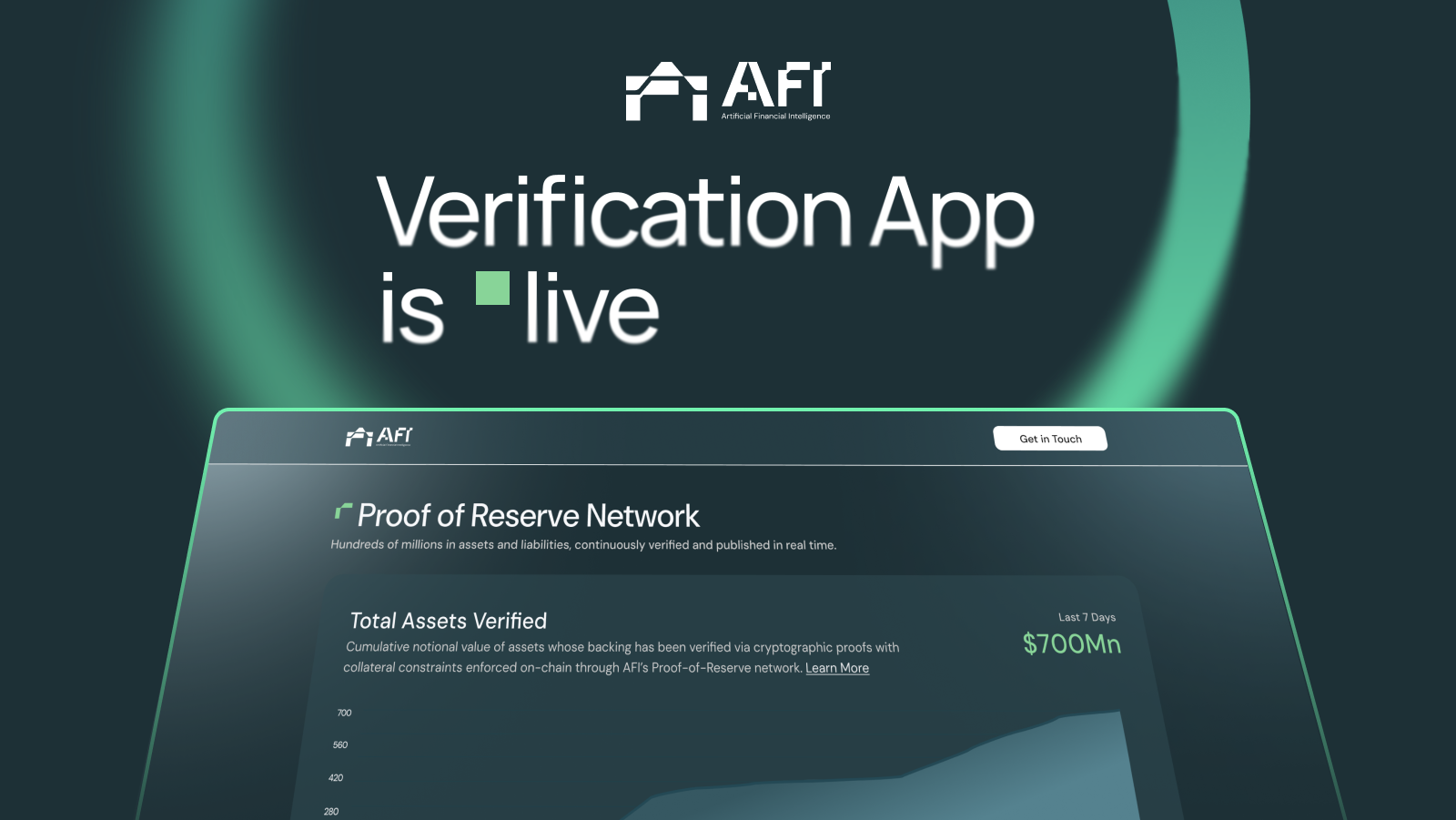
The AFI Verification App is a public facing tool that provides direct, user-accessible visibility into the verification state of assets secured by AFI's Proof-of-Reserve infrastructure. It surfaces three categories of information; each critical to the institutional-grade transparency model AFI is built in a single, independently usable interface.
Reserve Status
The app enables users to check the current reserve status of assets secured by AFI. This is not a cached or periodically updated figure, it reflects the live state of AFI's Proof-of-Reserve DVN (Decentralised Verification Network), providing a real-time snapshot of whether the assets backing on-chain instruments are verified as present and adequate.
For institutional participants evaluating whether to allocate into, hold, or redeem from an AFI-secured product, reserve status is the foundational data point: not "did this pass an audit six months ago?" but "what is the verified state right now?"
Attestation History
Beyond current status, the app provides a detailed history of attestations for each secured asset. Every attestation made by AFI's DVN verification nodes timestamped, cryptographically signed, and immutable is accessible through the app.
This attestation history is significant for several reasons. It allows users to evaluate the consistency of reserve verification over time, not just at a single point. It creates an auditable record that compliance teams, risk managers, and institutional counterparties can reference during due diligence. And it demonstrates that AFI's verification infrastructure operates continuously not periodically, not on-demand, but as a persistent, ongoing process.
Instead of waiting for a monthly report to confirm a fund's solvency, an attestation system can publish a proof of reserves to the blockchain every time a new block is mined. The AFI Verification App makes the output of exactly this kind of continuous attestation system directly accessible to every user.
Enforcement Signals
The third data category is the most novel: real-time enforcement signals. These are on-chain indicators that reflect how AFI's reserve verification is actively influencing protocol behaviour, whether minting constraints are active, whether circuit breakers have been triggered, or whether reserve thresholds are approaching levels that would affect issuance.
Enforcement signals represent the translation of Proof of Reserve from a passive reporting mechanism into an active governance layer. Rather than simply confirming that reserves exist, they communicate what the reserve state is doing to the protocol in real time giving users and integrators live visibility into the enforcement mechanics that govern rwaUSDi supply and other AFI-secured instruments.
Cryptographic Verification Without Custody Exposure
One of the most technically significant aspects of the AFI Verification App is how it achieves transparency: cryptographically verified data, without exposing custody details.
This solves a genuine tension in institutional reserve verification. Institutions holding large asset reserves have legitimate reasons not to disclose specific wallet addresses, custodian account details, or the precise composition of reserve holdings; disclosure of this information can create security risks, reveal competitive positioning, or conflict with custody agreements.
Conventional PoR approaches for centralised entities have navigated this tension imperfectly either requiring full custody disclosure (which institutions resist) or providing only aggregate figures that users must take on trust (which defeats the purpose of verification).
AFI's cryptographic verification model resolves this. The custodial assets are cryptographically verified without disclosing sensitive wallet addresses or private data, a design that provides users with independent verification of reserve adequacy while preserving the operational security and privacy requirements of institutional custodians.
For the RWA infrastructure context specifically where assets backing on-chain instruments include real-world holdings in regulated financial institutions this architecture is essential. It enables the transparency that DeFi participants expect without requiring custodians to publish information they cannot disclose.
Why Independent Verification Matters: The FTX Lesson and Its Institutional Legacy
The importance of the AFI Verification App cannot be fully understood without the context that created demand for it.
The collapse of FTX in November 2022 was, at its core, a failure of reserve verification. An entity controlling billions of dollars in user assets was operating without adequate, independently verifiable evidence that those assets existed. The absence of a mechanism for independent verification meant that warning signs were invisible until the collapse was already underway.
In the years following the high-profile exchange collapses of the early 2020s, the Web3 landscape has undergone a significant transformation. Recent regulatory scrutiny and new scoring methodologies have put Proof of Reserves in the spotlight, marking a shift towards proactive transparency measures, becoming a key requirement for establishing trust in the crypto ecosystem.
The institutional response to that collapse has been a sustained demand for verification mechanisms that are independent, continuous, and cryptographically binding, not periodic, self-reported, or dependent on the integrity of any single party. Proof of Reserves gives users the ability to check whether their funds are gone or in place. Because PoR proves a financial institution's solvency, panic-led bank runs can be avoided.
The AFI Verification App is the user-facing expression of this demand: a tool that gives any participant regardless of their technical sophistication the ability to independently verify the state of assets secured by AFI's infrastructure without trusting AFI's own disclosures.
From Verification to Enforcement: The Unique Value of Enforcement Signals
Most reserve verification tools stop at disclosure. They show you the reserve state. They may show you the history. But they do not show you what the system is doing with that information.
AFI's enforcement signals close this gap. They make the connection between reserve verification and protocol behaviour visible and user accessible allowing participants to see not just what the reserve state is, but how it is actively governing the protocol.
This distinction matters enormously for institutional participants who need to understand the operational mechanics of the products they hold. A compliance officer at an asset manager evaluating rwaUSDi needs to know not just that reserves are verified, but that the verification directly governs issuance that the minting cap is live, that it is connected to the verified reserve state, and that enforcement is automatic rather than discretionary.
Compliance attestation allows smart contracts to verify offchain facts such as whether a wallet belongs to a sanctioned entity or if a stablecoin is fully backed before executing a transaction. Enforcement signals are the real-time expression of this principle: on-chain evidence that compliance verification is actively shaping protocol execution, not just being recorded.
For the RWA tokenisation sector specifically, this is a significant capability. As tokenised assets scale toward the trillions and attract participants from regulated financial institutions, the ability to provide real-time evidence of automated enforcement rather than relying on periodic assurances that enforcement mechanisms exist is increasingly a prerequisite for institutional adoption.
The Verification App Within AFI's Full Infrastructure Stack
The AFI Verification App is not a standalone product, it is the user-facing interface of an infrastructure stack that has been built out methodically across each of AFI's previous milestones.
The underlying verification data surfaced by the app is produced by:
AFI's PoR DVN, the Decentralised Verification Network that provides continuous on-chain reserve verification through economically staked nodes. Through AFI's integration with Symbiotic's shared security framework, verification nodes have capital at risk behind every attestation false reserve confirmations are penalised through slashing, ensuring that the data the app displays is backed by cryptoeconomic consequences, not just cryptographic signatures.
The $600M confirmed reserve base on Multipli, against which a $150M minting allowance has been established for rwaUSDi a 4:1 reserve-to-supply ratio that the Verification App makes independently checkable by any user in real time.
The Quantstamp-audited ERC-4626 smart contracts governing AFI's yield vault infrastructure, whose integrity has been independently reviewed and whose behaviour the enforcement signals directly reflect.
The rwaUSDi Vault's $75M+ in TVL, representing the institutional capital deployed against the infrastructure that the Verification App now makes transparently verifiable to every participant.
Each layer of this stack contributes to what the Verification App surfaces. The reserve status reflects the DVN's live verification. The attestation history reflects the accumulation of cryptographically signed confirmations over time. The enforcement signals reflect the live connection between that verification and the smart contracts governing rwaUSDi supply.
What Automatic Solvency Enforcement Means for RWA Infrastructure
The launch description frames the Verification App as "another important step toward enforcing solvency in the system automatically." This framing deserves unpacking because automatic solvency enforcement is one of the most consequential capabilities in institutional-grade RWA infrastructure.
Manual solvency enforcement where a human or governance body decides whether and when to respond to a deteriorating reserve state introduces delay, discretion, and potential conflict of interest into the most critical operational decision in a reserve-backed financial system. By the time manual enforcement action is taken, harm may already be done.
Automatic solvency enforcement removes these failure modes. Connect reserve data directly to protocol logic to trigger circuit breakers, cap redemptions, or pause minting when reserve thresholds aren't met. In AFI's implementation, the enforcement signals visible in the Verification App reflect this automated governance: the protocol responds to reserve state changes without requiring human intervention, and users can observe those responses in real time.
For institutional participants, this represents a meaningful risk management upgrade over any reserve-backed product that relies on discretionary enforcement. An institution can monitor the enforcement signals directly, set their own triggers for portfolio review, and maintain continuous visibility into whether the protocol is operating within its defined reserve parameters without depending on AFI to proactively disclose when those parameters are being approached.
The Regulatory Dimension: Verification Apps as Compliance Infrastructure
The launch of the AFI Verification App coincides with a global regulatory environment that is increasingly treating on-chain reserve verification as a compliance requirement, not a voluntary best practice.
In the United States, the GENIUS Act has established reserve verification as a foundational requirement for stablecoin issuers mandating that supply be backed by verified reserves and that verification mechanisms be accessible to regulators and users. Cryptocurrency reserve verification has become the foundation of financial security in the modern crypto era.
In Europe, MiCA regulations require asset-referenced token issuers to maintain adequate, verifiable reserve backing and to provide transparency to token holders about the composition and adequacy of those reserves.
The AFI Verification App is designed to meet exactly this kind of regulatory expectation: providing independent, cryptographically verifiable, continuously updated reserve confirmation that any user including regulators and compliance teams can access without relying on the issuer's own reporting.
For AFI's institutional partners and the RWA protocols building on its infrastructure, the Verification App functions as a compliance asset: a public, independently usable tool that demonstrates regulatory alignment through verifiable transparency, not verbal assurance.
Key Benefits for Different Participant Types
For institutional investors holding rwaUSDi or AFI-secured assets: Real-time, independent verification of reserve status without depending on periodic disclosures or trusting AFI's internal reporting. Attestation history enables continuous due diligence across the life of an investment, not just at entry.
For DeFi protocols integrating AFI-secured collateral: Enforcement signals provide live visibility into whether the collateral asset is operating within its reserve parameters; critical for risk management systems that need to respond to collateral state changes in real time.
For compliance and risk teams at regulated institutions: The Verification App provides an independently accessible, cryptographically verifiable record of reserve adequacy, meeting the transparency requirements of MiCA, the GENIUS Act, and equivalent frameworks without requiring additional reporting infrastructure.
For RWA infrastructure builders: A reference implementation of what user-facing reserve transparency looks like when it is built correctly; cryptographic verification, custody privacy, attestation history, and enforcement signal visibility, all in a single accessible tool.
Conclusion
The AFI Verification App represents the completion of a loop that most reserve-backed protocols leave open: the loop between verification and visibility. AFI has built the verification infrastructure; the DVN, the Symbiotic integration, the Quantstamp-audited smart contracts, the $600M confirmed reserve base. The Verification App makes all of it independently visible, continuously accessible, and cryptographically trustworthy for every participant in the ecosystem. In a DeFi landscape still working to rebuild institutional confidence after years of opacity, this kind of verifiable transparency infrastructure is not a feature, it is the foundation.