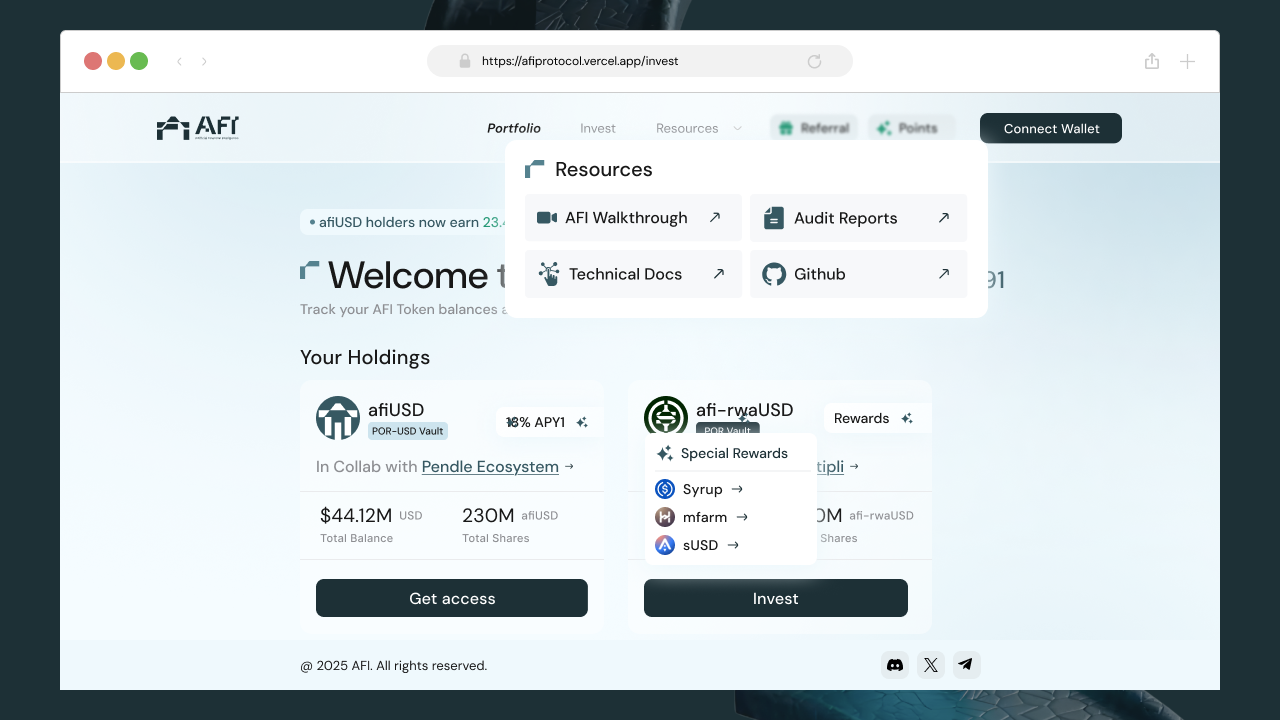
Introduction
The distinction between speculation and structure has never mattered more in DeFi. For years, yield in decentralised finance was synonymous with hidden leverage, opaque mechanics, and trust-us-bro backing. AFI (Artificial Financial Intelligence) is drawing a hard line against that model. With $76M+ already in total value locked, AFI Yield Vaults are now live for institutions and every dollar inside them is mathematically capped by verified reserves. This isn't yield farming. This is capital-grade DeFi with enforced constraints, verifiable backing, and Proof of Reserve built in from day one.
The Problem With DeFi Yield: Why "Trust Us" Is No Longer Enough
To understand why AFI Yield Vaults matter, you need to understand the problem they are solving.
The DeFi yield market has grown enormously. DeFi lending protocols collectively secure over $78 billion in TVL as of 2025, and curated vaults have grown 28x in total value locked over the past 12 months, jumping from under $150M in June 2024 to more than $4.4 billion. That growth reflects genuine institutional appetite but it has also outpaced the infrastructure needed to support it safely.
The majority of DeFi yield products share a structural weakness: yield is generated through mechanisms that obscure leverage, rely on unverified assumptions about underlying collateral, or depend on token incentives that evaporate when market conditions shift. For retail participants tolerating high risk, this may be acceptable. For institutions managing regulated capital, it is not.
The risks are well-documented. Smart contract exploits have cost billions in 2025 alone. Over-leveraged vaults have collapsed without warning. Protocols claiming asset backing have been unable to verify it on-chain. And through every cycle, the phrase "trust us" has proven to be the most expensive promise in DeFi.
AFI Yield Vaults eliminate this problem at the architecture level.
What Are AFI Yield Vaults?
AFI Yield Vaults are yield-bearing on-chain vaults backed by real-world assets and on-chain strategies, governed by one foundational constraint: every dollar minted is mathematically capped by verified reserves.
This design is powered by AFI's Proof-of-Reserve (PoR) DVN (Decentralised Verification Network) the same infrastructure layer that AFI has integrated with Symbiotic's shared security framework and that underpins its Quantstamp-audited ERC-4626 smart contracts.
The result is a yield product with three defining properties that separate it from conventional DeFi vaults:
1. No Over-Issuance Minting within AFI Yield Vaults is mathematically constrained to verified reserve levels. No dollar of yield exposure can be created without a corresponding verified asset backing it. This eliminates the fractional-reserve dynamics that have destabilised other DeFi yield protocols.
2. No Hidden Leverage Conventional DeFi yield strategies often stack leverage across lending protocols, liquidity pools, and synthetic exposure — obscuring the true risk profile of a position. AFI Yield Vaults are designed with enforced constraints that make leverage visible and bounded.
3. Verifiable Backing from Day One Rather than relying on periodic disclosures or trusted custodians, AFI's PoR infrastructure provides on-chain verification of the assets backing each vault. Anyone can verify the reserve status at any time — without trusting an intermediary.
$76M+ in TVL: What It Signals About Institutional Demand
The $76 million in TVL already locked in AFI Yield Vaults at launch is not just a headline number it is a meaningful data point about institutional appetite for structured, verifiable yield.
Capturing just 1–2% of global money-market and cash-sweep assets could push vault TVL beyond half a trillion dollars by 2030. The institutions leading that capital deployment are not looking for the highest advertised APY they are looking for products that meet their fiduciary, compliance, and risk management requirements.
AFI's $76M+ launch TVL reflects early adopters who have evaluated the vault on exactly those criteria:
- Verified reserves, not assumed backing
- Audited smart contracts, not untested code
- Enforceable constraints, not voluntary disclosures
- Transparent on-chain mechanics, not black-box strategies
From Apollo's private credit vault to Coinbase's Bitcoin-backed loan flow, institutions are no longer just exploring vaults; they're deploying real capital through permissioned DeFi infrastructure. AFI Yield Vaults are purpose-built for this same institutional cohort with the added layer of Proof of Reserve verification that most institutional-grade products still lack.
How Proof of Reserve Makes AFI Yield Vaults Different
Proof of Reserve (PoR) is a mechanism for verifying on-chain that the assets claimed to back a financial product actually exist and are held in custody. In the context of AFI Yield Vaults, PoR does more than verify it enforces.
The Minting Cap Mechanism
AFI's mathematical minting cap is powered by real-time reserve verification. The vault's issuance logic directly references the verified reserve state: if verified reserves decline, minting capacity is automatically constrained. This means the vault cannot grow beyond what its verified assets can support not by design choice, but by mathematical enforcement.
This is structurally different from protocols that claim 1:1 backing but rely on voluntary disclosure or periodic audits to confirm it. AFI's PoR infrastructure provides continuous, on-chain verification making the reserve constraint self-enforcing rather than trust-dependent.
Capital-Backed Verification Through Symbiotic
AFI's PoR DVN is integrated with Symbiotic's shared security framework, meaning the verifiers attesting to reserve states have economic capital at risk behind every claim. False attestations result in slashing direct financial consequences for dishonest verification.
This transforms PoR from a reporting layer into an enforcement layer. For institutional participants, it means the reserve verification infrastructure securing their vault deposits carries the same cryptoeconomic security properties as Ethereum validator behaviour where dishonesty is made costly by design.
Audited Smart Contract Integrity
The ERC-4626 vaults underlying AFI's yield product have passed a comprehensive Quantstamp security audit reviewed for the specific vulnerabilities most dangerous in reserve-backed vaults: inflation attacks, reentrancy exploits, oracle manipulation, and improper totalAssets accounting.
The audit, the PoR enforcement, and the Symbiotic integration form a complete security stack: verified backing, economically enforced attestation, and audited contract integrity, all operating simultaneously.
Why Institutions Are Moving Capital Into DeFi Vaults
The shift of institutional capital into on-chain yield products is not speculative, it is underway and accelerating.
Real-world asset tokenisation expanded from approximately $8.5 billion in early 2024 to $33.91 billion by Q2 2025, representing 380% growth over three years. Institutions that once viewed on-chain finance as a peripheral experiment are now deploying against it as core treasury infrastructure.
A clear shift took place in 2025: DeFi applications began generating more fees than the underlying blockchains they operate on. Yield, structured correctly, has become a legitimate asset management tool not just a speculative mechanism.
The barrier that has held back institutional adoption is not lack of yield opportunity. It is a lack of verifiable, compliant, risk-managed yield infrastructure. The primary bottleneck is governance, not strategy access. Vaults handle strategy; participants retain custody and can withdraw on demand.
AFI Yield Vaults are designed precisely for this environment: high-transparency, high-constraint, reserve-verified yield products that an institutional allocator can defend to a risk committee, present to a regulator, and integrate into an existing compliance framework.
Capital-Grade DeFi: What It Actually Means
Capital-grade DeFi is a term that appears increasingly in institutional crypto conversations but it requires a precise definition to be meaningful.
For AFI, capital-grade DeFi means yield infrastructure that meets the following standards simultaneously:
Structural transparency: Every constraint, every reserve state, every minting limit is verifiable on-chain without requiring trust in any intermediary.
Enforced risk limits: Leverage, issuance, and exposure are mathematically bounded not guideline-constrained.
Independent security verification: Smart contract integrity is confirmed by a recognised third-party auditor, not self-attested.
Economic consequence for dishonesty: Verification nodes have capital at risk. False reserve claims are penalised financially, not just reputationally.
Composability with institutional infrastructure: ERC-4626 standardisation ensures the vaults integrate cleanly with existing DeFi protocols, custody solutions, and treasury management workflows.
AFI Yield Vaults meet all five. Together, these properties produce something that has been largely absent from DeFi's yield landscape: a product that a regulated institution can use without treating it as an exception to their risk management framework.
The Broader Significance: A New Standard for On-Chain Yield
AFI Yield Vaults going live represents more than a single product launch. They signal a structural transition in how on-chain yield is designed and offered.
The dominant DeFi yield model, high APYs sustained by token emissions, leverage recycled across protocols, and collateral verified only on request is losing credibility among the capital pools that matter most for long-term DeFi growth. Institutional allocators, sovereign wealth structures, corporate treasuries, and regulated asset managers are not deploying capital into systems they cannot independently verify.
The winners in DeFi are not simply the protocols with the most users or the most TVL, but those with durable execution, credible risk frameworks, and clear economic models that still function when incentives fade.
AFI's Yield Vaults are a direct expression of this principle. By building Proof of Reserve verification, audited smart contracts, and mathematical minting constraints into the foundational layer, AFI is defining what capital-grade on-chain yield looks like not as a regulatory accommodation, but as a design philosophy.
As tokenisation scales and more real-world asset value moves on-chain, the infrastructure layer beneath it must be held to the same standard. AFI Yield Vaults set that standard.
Conclusion
DeFi has a yield problem not a shortage of it, but a shortage of yield that institutions can trust. AFI Yield Vaults solve this directly: with $76M+ already locked, mathematically enforced reserve constraints, Proof-of-Reserve verification backed by economic slashing, and Quantstamp-audited smart contracts, they represent the clearest articulation yet of what capital-grade on-chain yield looks like. As the tokenisation of real-world assets scales toward the trillions, the yield infrastructure sitting above those assets must be held to the same standard. AFI is building exactly that.