Introduction
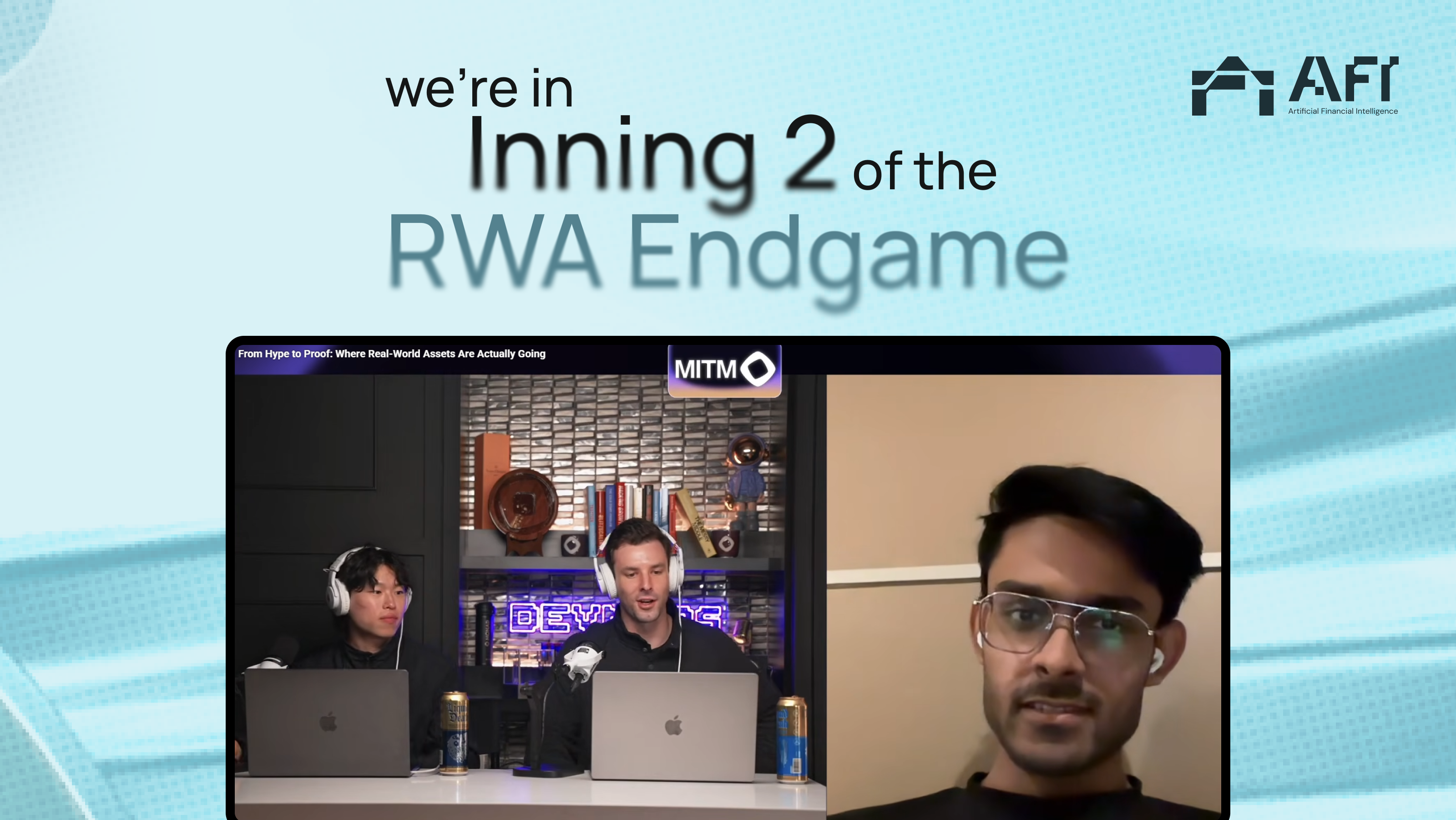
What does the endgame for on-chain real-world assets actually look like and how far away are we? AFI CEO Sudipan Sinha went deep on exactly these questions in a recent appearance on MITM Season 2 with pipeline_xyz. No narratives. No hype. Just an honest account of where the RWA sector is, why most of what passes for "tokenisation" today is still partial transparency wrapped in good marketing, and what inning 9 looks like when the game is actually won. Here's the full breakdown.
Watch the Full Conversation
Embed video: https://youtu.be/1nIhHEBpZOE
The conversation covers ground that most RWA discussions avoid: the infrastructure endgame, who actually captures value in a mature on-chain capital market, and the specific design decisions that separate real reserve-backed yield from "trust me bro" mechanics. If you're building in DeFi and not thinking about reserves, this conversation is a 2-minute reset on what you're missing.
Why AFI Exists: From "Trust Me Bro Yield" to Verifiable Proof of Reserve
The starting point of the conversation is the problem AFI was built to solve and it is a problem that the RWA sector has been slow to confront directly.
Most yield products in DeFi, even those marketed as "RWA-backed," rely on what the conversation calls "trust me bro mechanics": an issuer or protocol claims reserves exist, publishes periodic attestations, and asks participants to trust that the situation has not changed materially between reporting cycles. For retail DeFi users this may be an acceptable trade-off. For institutional capital regulated asset managers, corporate treasuries, pension funds it is a fundamental barrier to entry.
AFI was built to replace that trust-based model with something verifiable. Its Proof-of-Reserve DVN (Decentralised Verification Network) provides continuous, on-chain reserve verification with verification nodes that have economic capital staked through Symbiotic's shared security framework. False reserve attestations are penalised through slashing. Every confirmed reserve state is cryptographically signed and publicly verifiable.
The result is a system where "the reserves are there" is not a claim backed by reputation, it is a statement backed by capital at risk. That distinction is the entire reason AFI exists.
Direct RWA token exposure consistently underperforms. The economic value from tokenisation accrues to curators and issuers, not governance tokenholders. The infrastructure layer; verification, enforcement, custody, attestation; is where durable value accumulates in a maturing RWA market.
Inside the $50M RWA Stablecoin Vault on Monad
One of the most concrete parts of the conversation covers what is actually happening inside the rwaUSDi vault, now expanded to include deployment on Monad and how the Proof of Reserve framework governs it at the operational level.
The vault is not a static product. It is live infrastructure: supply programmatically capped by verified reserves, minting constrained by AFI's DVN confirmation, and yield generated through Multipli's institutional delta-neutral strategies sourced from Nomura, Fasanara, and Edge Capital.
Every dollar in the vault exists beneath a mathematical ceiling derived from confirmed reserves. AFI has confirmed $600 million in verified reserves on Multipli, against which a $150 million minting allowance has been established, a 4:1 reserve-to-supply ratio. No issuance can occur beyond what the reserve confirmation supports. No trust-based assumptions govern the relationship between reserves and supply.
What this looks like in practice, how the Verification App makes the reserve state, attestation history, and enforcement signals independently checkable by any user is exactly the kind of operational detail that the MITM conversation gets into.
The RWAs We're Bullish On and What Comes After the Current Wave
Not all tokenised assets are created equal. The conversation draws a line between the RWAs that have demonstrated genuine product-market fit and the categories still operating as narrative first experiments.
The current wave is anchored by tokenised U.S. Treasuries, which crossed $5.8 billion on-chain by March 2026 led by BlackRock's BUIDL, Ondo Finance, and Franklin Templeton's BENJI. These products work because the underlying asset is simple, standardised, and already familiar to institutional allocators. Settlement is clean, yield is predictable, and the legal structure is well tested.
Private credit is the next meaningful category. Tokenised private credit now represents over $18.91 billion in active on-chain value, offering yields of 12-15%, significantly above the 4-5% available in Treasury products. The trade-off is complexity: private credit has real settlement delays, less standardised legal structures, and more counterparty dependency. The RWA protocols that are winning in private credit are those that have solved the custody, verification, and redemption mechanics, not those that simply marketed the yield.
The categories that come after the current wave; commodities, real estate, infrastructure debt, private equity are more complex still. They require better oracle infrastructure, more sophisticated legal wrappers, and verification systems capable of handling heterogeneous asset types. This is where the infrastructure conversation becomes the central one: not what to tokenise, but how to verifiably enforce the backing of what has been tokenised.
How Multipli Went from a Conversation to Powering Real On-Chain Capital
The partnership between AFI and Multipli is not a marketing arrangement or a co-branded product launch. It is a live infrastructure collaboration that has produced a vault now tracking $75M+ in TVL with $600M in verified reserves confirmed on-chain.
Multipli brings the institutional yield architecture: the AlphaIQ engine that dynamically allocates capital across delta-neutral strategies from top-tier asset managers, generating market-direction-independent returns for institutional participants. AFI brings the verification and enforcement layer: the PoR DVN that confirms the reserve state, the mathematical minting cap that enforces supply discipline, and the Quantstamp-audited ERC-4626 smart contracts that govern the vault's operation.
The conversation traces how this partnership evolved from a shared diagnosis of the problem (institutional capital needs verifiable yield infrastructure, not just yield) to a live product attracting the kind of capital that requires it. The story of Multipli going from a conversation to powering real on-chain capital is a case study in how the RWA infrastructure layer gets built: through collaborations between protocols whose capabilities are architecturally complementary, not through unilateral product launches.
What Happens When RWAs Actually Scale On-Chain: The Value Capture Question
The most analytically substantive part of the conversation is the question of who captures value as the RWA market scales from tens of billions toward the projected $10+ trillion range by 2030.
The answer, according to the conversation, is not the protocols most people assume. Governance tokens of RWA-adjacent protocols have consistently underperformed as the underlying markets grew. The economic value from tokenisation accrues to curators and issuers, not tokenholders. Kamino Finance on Solana illustrates this pattern clearly: 80% deposit growth alongside a 16% token decline over the same period.
The value capture happens at the infrastructure layer; the verification systems, the custody solutions, the enforcement mechanisms, the oracle networks, the attestation standards. These are the components that institutional capital cannot circumvent as it enters on-chain markets. They are also the components that most DeFi protocols currently treat as commodity inputs rather than strategic differentiators.
AFI's positioning is an explicit bet on this thesis: that the Proof-of-Reserve verification layer, the minting enforcement infrastructure, and the institutional compliance tools are where durable value accumulates in a mature RWA market. The infrastructure, not the tokens, captures the real value.
Inning 2-3: Where the Market Actually Stands
The CEO's framing of the current RWA market as "inning 203" is not pessimism, it is calibration. And it is more accurate than most assessments of the sector's maturity.
Inning 1 was the narrative phase: proving that tokenisation was technically possible and that institutions would engage. BlackRock launching BUIDL, Franklin Templeton deploying BENJI, Fidelity entering the tokenised yield space these are inning 1 achievements. Important, but primarily demonstrative.
Inning 2–3 is where we are now: products with genuine product-market fit (tokenised Treasuries), emerging institutional infrastructure (permissioned lending markets, reserve verification systems, cross-chain deployment), and the first real attempts to solve the hard problems of verification and enforcement at scale.
We are still in the installation phase of the RWA super-cycle. The infrastructure is being built. The next five years (2026–2030) are the deployment phase. The direction of travel is clear, but most of the work remains ahead.
The current wave of RWAs most accurately described as "wrapped narratives with partial transparency" will be replaced by something categorically different. The question is which protocols will be part of that replacement, and which will not survive the transition from narrative to infrastructure.
Inning 9: What the Endgame Looks Like
The conversation's articulation of "inning 9" is worth taking seriously as a design specification for what the market needs to build toward, not just as a vision statement.
Every dollar on-chain is backed, provable, and enforced. Not audited annually. Not attested periodically. Backed continuously, by verified reserves, with minting constraints that are mathematically enforced in code.
Capital moves across chains with verification, not blind trust. Cross-chain asset transfers in the current market require trusting bridges and custodians. Inning 9 means cross-chain capital movement with cryptographically verified reserve integrity at every step enforced by economic slashing if verification nodes behave dishonestly.
Yield is priced on risk, not marketing. The current market rewards protocols that market yield effectively, regardless of whether the yield is sustainable or the reserves verifiable. Inning 9 means risk-adjusted pricing of on-chain yield where verifiable reserve status and enforcement quality directly influence the rate that institutional capital will accept.
Infrastructure, not tokens, captures the real value. The middleware layer verification, custody, attestation, enforcement becomes the indispensable substrate of a multi-trillion-dollar on-chain capital market. The protocols that have built and scaled that layer when inning 9 arrives will have captured the most durable value in the market.
The total addressable market is not billions. Not trillions. It is the rewriting of how global capital is verified and moved. The BIS has projected that 10% of global GDP could be tokenised by 2034 meaning the infrastructure layer beneath that tokenised capital is the foundation of a system managing more capital than any existing financial infrastructure.
The Builder's Takeaway
The CEO closes with a challenge that is as direct as anything in the conversation: if you are building in DeFi and not thinking about reserves, you are already behind.
This is not a commentary on compliance. It is a commentary on architecture. The DeFi protocols that will attract institutional capital at scale are those that have built reserve verification into their design not as a feature added after the fact, but as the foundational constraint from which everything else derives.
The rwaUSDi Vault, the AFI Verification App, the integration with Symbiotic's shared security, the Quantstamp audit each of these is an expression of the same architectural philosophy: that verifiable reserves are not a nice-to-have, but the load-bearing infrastructure of any on-chain financial system that institutions will trust.
Building in DeFi today means choosing whether to be part of inning 2–3 infrastructure wrapped narratives with partial transparency or to be part of what makes inning 9 possible.
Conclusion
The RWA conversation has been dominated by narratives: what will be tokenised, which chains will win, what yields are possible. AFI's CEO went in the opposite direction on MITM S2 focusing on what has to be built for the endgame to be reachable at all. Verifiable reserves. Enforced supply discipline. Risk priced yield. Infrastructure that captures value rather than tokens that claim it. We are inning 2-3. Inning 9 requires doing the infrastructure work now. AFI is building it.